Marketing
2 Dec 2025
2025 Black Friday incentives benchmark report
 "Isabelle Watson Talon.One")
Isabelle Watson
Head of PR & Special Projects
 "Black Friday discount rates 2025")
Jump to
The 6 Black Friday strategy trends that defined 2025
1. Timing: When did discounting begin?
2. Spend: 2025 broke the “Wait until black friday” habit
3. Rates: How high were discounts in 2025?
4. Loyalty: How did member engagement shape BFCM performance?
5. Type: What promotion mechanics won BFCM 2025?
6. Scalability: Enterprise performance at Black Friday scale
Black Friday and Cyber Monday have undergone a dramatic transformation over the past years.
What was once a predictable, two-day peak has evolved into a multi-week global shopping cycle, shaped by shifting consumer behaviour and competition for attention.
Using aggregated, anonymized data from roughly 300 leading brands across our platform — and building on last year’s Black Friday Trends Report — we analyzed how promotional behavior evolved in 2025. This includes:
When retailers begin their holiday ramp-up
How events like Singles’ Day and Member Weeks are reshaping demand
How discount rates shifted across regions
Which promotional mechanics best convert
And how Talon.One scaled to support record-breaking, high-throughput traffic
As the incentives engine powering some of the world’s best-loved retailers, Talon.One offers a front-row seat to how customer behaviour is shifting in real time. The result is a practical benchmark for brands who want to measure their 2025 performance and set their 2026 strategy.
The 6 Black Friday strategy trends that defined 2025
1. Timing: When did discounting begin?
The defining shift in 2025 was timing. BFCM 2025 arrived earlier - and stretched longer - than any year before.
In 2024, we saw a sales spike begin on November 21. This year, the surge started even earlier.
Influenced revenue rates - that is, any sale made with a promotion or discount attached - saw a steep rise on November 16, almost two weeks before Black Friday. Brands including Dyson, John Lewis and Curry’s launched deals within the first week of November, signalling a shift toward an elongated BFCM season.
Retailers didn’t just start their BFCM deals earlier; they pulled customers into a long runway of value moments spanning October and November.
Member Weeks continued their ascent: We saw more retailers than ever running pre-season “member-first” events throughout October and early November. These generated multiple demand spikes before Black Friday even began.
Retailers from Alo Yoga to Best Buy positioned their Members’ Weeks as headline loyalty moments, offering exclusive discounts, early access, bundles, and gifts with purchase. Member Weeks have become a strategic retention lever that warms up demand ahead of BFCM, distributing revenue more evenly across Q4 - and loyalty programs have become the gateway to value.
Singles’ Day, historically an APAC phenomenon and held every year on November 11, became an even bigger global value event in 2025 - representing one of the earliest and strongest indicators of the holiday season.
At Talon.One, year-over-year, we saw a fitting 11% increase in influenced revenue on Singles’ Day compared to 2024. Major US and EMEA retailers joined the surge this year, from ASOS to Levi’s - influencing customer expectations well before BFCM.This confirms a long-term trend: BFCM is now the peak of a multi-event promotional season, not a standalone moment. The most successful retailers are preparing for revenue spikes across multiple events - Member Weeks, early November push, 11/11 and Cyber Week - rather than funnelling their entire strategy into two days.
)
2. Spend: 2025 broke the “Wait until black friday” habit
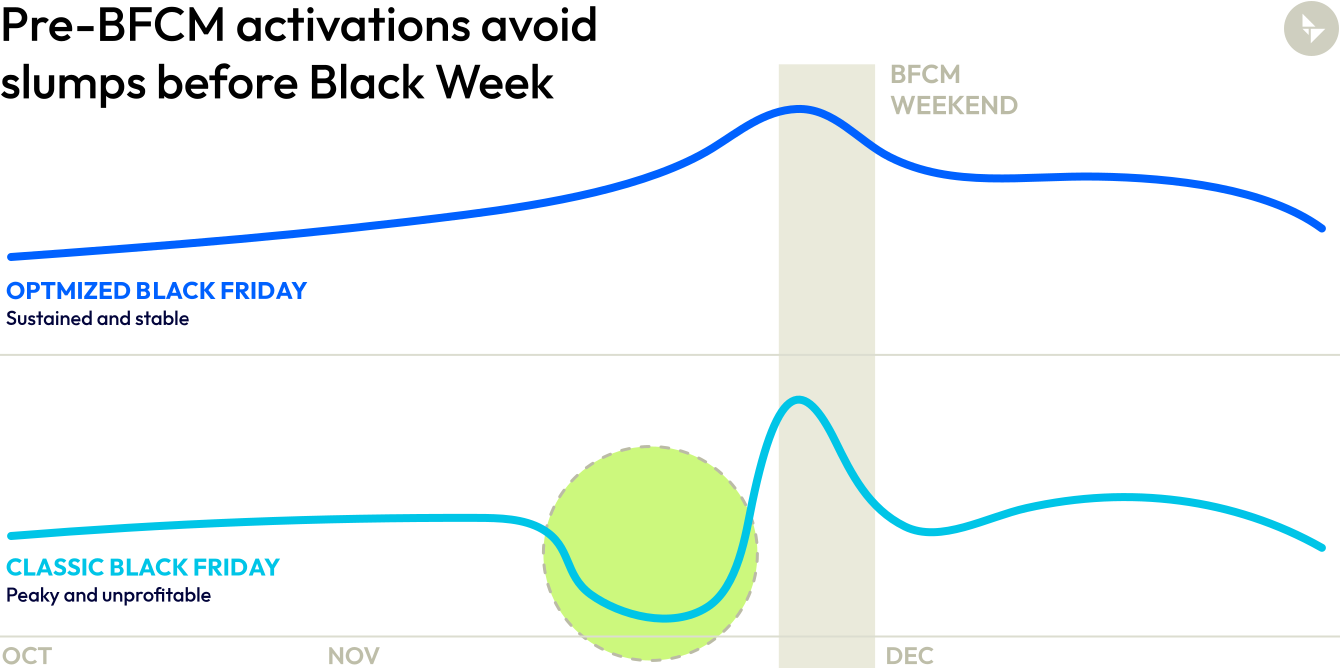
For years, online shopping patterns followed a predictable arc: a deep pre-BFCM slump, followed by a huge, peaky, and often unprofitable Black Friday spike. Shoppers had been conditioned to hold off purchasing until the full breadth of Black Week deals dropped — creating volatility that hurt margins and distorted demand planning.
This year marked a turning point. With retailers deliberately optimizing the BFCM season, they were able to successfully soften the pre-Black Friday dip in spending.
Our data shows these activations stabilized conversion rates, preventing the traditional slump.
Looking ahead to December, this year’s shopping season has also laid the groundwork for stronger post-BFCM reactivation. Historically, very few BFCM shoppers returned before the end of the holiday period. But this year, we anticipate that loyalty-driven value - points, earned rewards, and exclusive member perks - will generate a meaningful bounceback effect, sustaining traffic well into December.
3. Rates: How high were discounts in 2025?
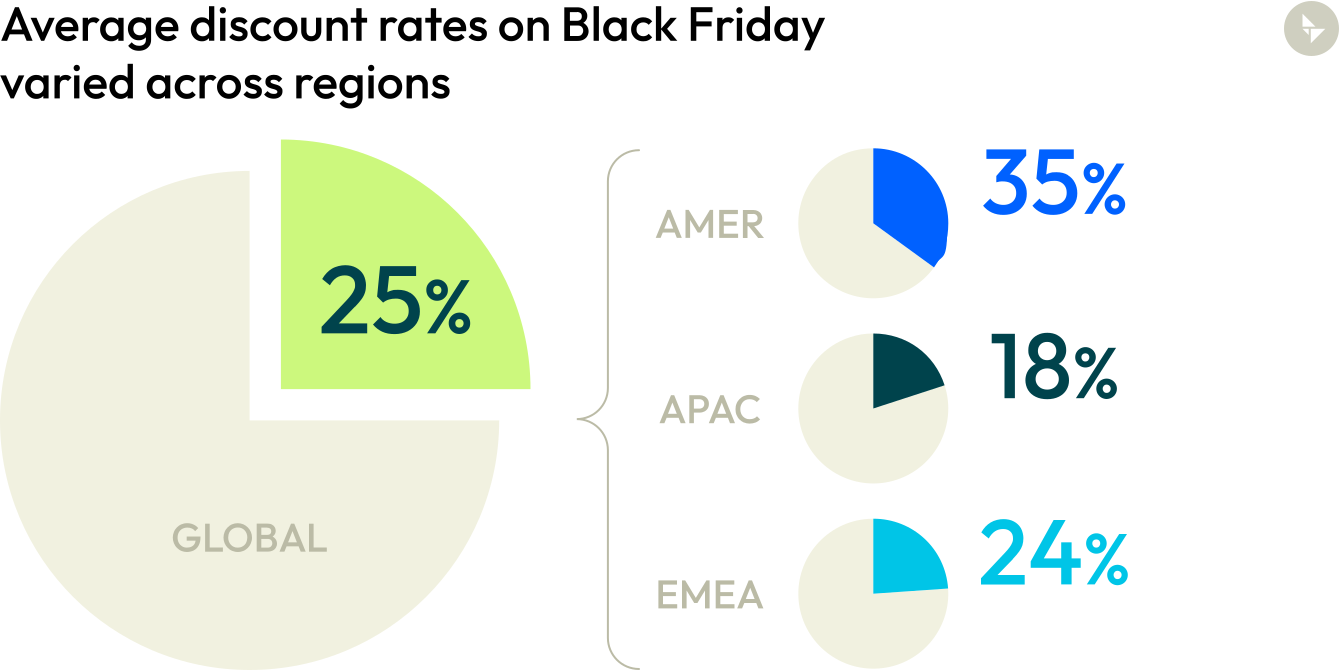
In the current climate, value is the top priority for shoppers, and retailers have responded by increasing their Black Friday discounts. The modest uplifts tells us that retailers acted strategically rather than resorting to deep, margin-draining cuts.
Average discount rate on Black Friday
2024 global average: 21%
2025 global average: 25%
Regional differences
US: 35%
EMEA: 24%
APAC: 18%
4. Loyalty: How did member engagement shape BFCM performance?
2025 reinforced the importance of loyalty as a core driver of customer engagement during the holiday season. Shoppers enrolled in programs at record rates, showing that they’re willing to hand over data and engage more deeply if it guarantees consistent value.
Across Talon.One retailers, we saw a 50% increase in daily new members on Black Friday compared to the previous 30-day average.
Overall, loyalty enrollment doubled compared to last year’s Black Friday - showing that loyalty programs are now the “first filter” for meaningful incentives. Retailers used loyalty memberships as the gateway to better discounts, higher-tier bundles, and priority access.
5. Type: What promotion mechanics won BFCM 2025?
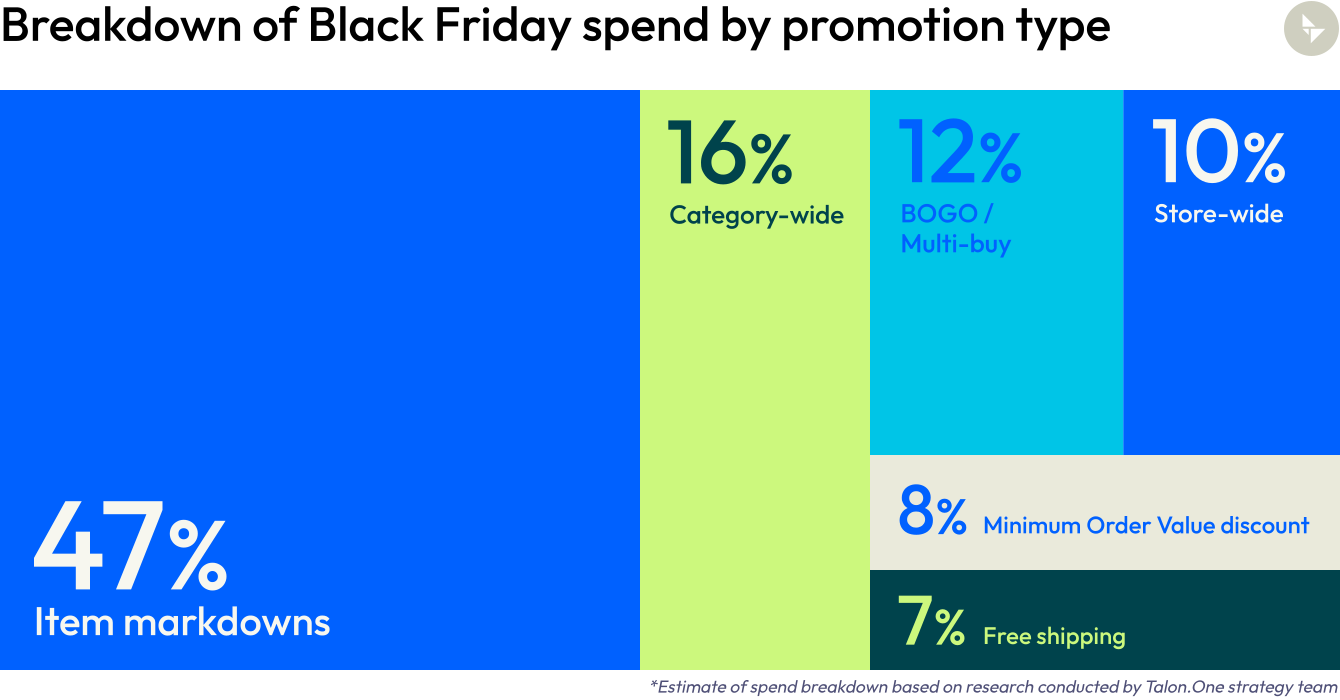
Across all Talon.One retailers, simple item discounts continued to account for the majority of BFCM promotions. They remain the most familiar, easiest to execute, and fastest to communicate value to customers.
But beneath that familiar foundation, we saw a meaningful rise in more structured, value-engineered mechanics designed to protect margins and lift overall basket value. These layered mechanics allowed brands to stretch beyond blanket markdowns, using promotions more strategically to influence shopper behaviour.
Retailers increasingly paired their core discounts with:
Tiered and minimum Average Order Value incentives to encourage higher spend
Bundles and Buy One Get One offers that shift focus from margin to volume
Shipping incentives that remove key conversion barriers
Member-exclusive pricing and perks that boost loyalty participation
6. Scalability: Enterprise performance at Black Friday scale
Black Friday continues to be the ultimate stress tests for promotional infrastructure - and this year, Talon.One delivered industry-leading performance at global scale.
Across Black Friday week, Talon.One powered:
2.4 billion API requests
105k peak requests per second
1.34 billion rule evaluations
The ability to support real-time incentives at this volume and speed is essential as promotions become more personalized, more dynamic, and more deeply embedded within the customer journey.
Scalability is now table stakes. As retailers deploy higher volumes of personalized promotions, the infrastructure behind them must be resilient, real-time, and globally performant.
TLDR: What this means for retailers heading into 2026
BFCM 2025 made one thing clear: the holiday shopping landscape is no longer defined by a weekend but by an entire season of orchestrated value moments.
The winners in 2026 will be the retailers who:
Plan for multi-peak seasons, not just Black Friday
Use incentives to optimize both conversion and margins
Make loyalty the centrepiece of their promotional strategy
Invest in scalable infrastructure that can support billions of real-time interactions
Ready to level up your incentive strategy for 2026? Explore our Buyer’s Guide to find the right incentives engine for your business, and dive deeper into best-practice frameworks with our Getting Strategic About Incentives report.

)
Monthly loyalty newsletter
Join thousands of marketers and developers getting the latest loyalty & promotion insights from Talon.One. Every month, you’ll receive:
Loyalty and promotion tips
Industry insights from leading brands
Case studies and best practices


Isabelle Watson
Loyalty & promotion expert at Talon.One

- Product
- Enterprise loyalty management
- Offer management & execution
- Personalized promotions
- Talon.One Predict
- Company
- About us
- Press
- Jobs
- Contact us
Get the latest incentives insights, delivered straight to your inbox.

