Marketing
30 Sept 2026
Gamified promotions: Make discounts feel earned

Reza Javanian
Talon.One loyalty expert

Gamified promotions work when they create profitable behavior that a generic discount would not. The goal is not more spins, badges, or redemptions. It is incremental contribution after reward cost, operational cost, and loyalty liability.
In this blog post, we will look at what gamified promotions are and how to run them profitably, including:
Core mechanics: The challenge, streak, tier, and chance formats brands use most often, and which customer behavior each one is built to influence.
Reward economics: How to tell whether a game is protecting margin or quietly eroding it, and what to measure before scaling.
Implementation and controls: The technology stack and safeguards that keep hundreds of overlapping campaigns fair, accurate, and on budget.
What gamified promotions are
Gamified promotions use game mechanics to deliver incentives instead of handing them out unconditionally. A customer spins a wheel, completes a challenge, maintains a streak, or collects pieces toward a prize. The reward still carries monetary value, but earning it requires an action first.
A plain discount code centers on the transaction alone. A gamified promotion adds a layer where customers share preferences or complete non-transaction actions to unlock the reward. This layer can extend attention beyond checkout and generate behavioral data the brand lacked before, the same signal that shapes broader loyalty program design.
Gamification can make a reward feel more valuable without increasing its face value. It protects margin only when the incremental contribution from changed behavior exceeds the reward cost and the operational cost of running the campaign. It must also cover any future loyalty liability the mechanic creates.
Redemption volume and participation rates measure engagement. They do not by themselves measure profit.
McDonald's 2025 Monopoly relaunch shows the reach a well-known mechanic can have. Customers registered through the McDonald's app, opted into MyMcDonald's Rewards, then collected physical and digital game pieces tied to menu purchases. McDonald's fourth-quarter revenue rose 10 percent to more than $7 billion.
The company credited Monopoly and a Grinch-themed promotion among the campaigns that drove strong traffic that quarter. Monopoly was one contributor among several, not the sole cause of the result.
Core mechanics and the behavior each one targets
Brands should match the mechanic to the behavior they want and to how often the customer normally buys. The most common formats include:
Challenges and quests: Time-bound or action-bound tasks that pay out on completion. Chipotle's Summer of Extras shows the scale this format can reach. The 2025 program drove 6.4 million activations and an estimated $12 million in incremental sales, according to Chipotle.
Streaks: Consecutive actions that increase rewards or add recognition. Scooter's Coffee automates Visit Challenges and personalized dayparting promotions to drive repeat visits, one of several loyalty program strategies built around repetition.
Tiers and status: Progression systems built on a visible level to climb. Chick-fil-A One moves more than 50 million members through four tiers: Member, Silver, Red, and Signature. That structure is one of several tier and cashback models brands use to organize progression.
Chance mechanics: Spin-to-win wheels, scratch cards, and Monopoly-style collection games that add anticipation to the reward, mechanics that show up across several retail gamification examples.
Recognition mechanics: Badges, leaderboards, and point multipliers that create visibility or friendly competition around an existing points program. Evaluating gamification software for this layer means checking how well it supports exactly these mechanics.
For brands targeting younger, digital-first loyalty audiences, entertainment and visible progress can be useful differentiators. Customer research, not assumption, should confirm whether a given mechanic actually improves participation and perceived value for that audience before it becomes a program pillar.
Behavioral design, transparency, and trust
Game mechanics draw on several distinct behavioral patterns, and each has real limits.
Uncertain rewards can heighten anticipation and participation, particularly when the expected value is clear and the odds are transparent. Uncertainty should not replace a reliable core value proposition. In some cases, customers rationally prefer a guaranteed reward of equal expected value over a variable one.
Visible progress toward a goal can motivate continued action, an effect documented in goal-gradient research. A head start can amplify this because the goal feels closer, even when the remaining effort is unchanged. A streak about to break can trigger a stronger response than an equivalent future gain, consistent with loss-aversion research.
Brands still need to design for interruption. Customers travel, get busy, and lapse, so a grace period and clear expiration reminders keep the mechanic from feeling punitive. That flexibility belongs in personalized loyalty reward logic rather than bolted on afterward.
Overusing small transactional rewards can train customers to wait for an incentive before acting. Strong programs balance monetary value with recognition, access, and genuinely useful member benefits, so engagement does not collapse the moment payouts stop.
Regulatory attention to mechanics that exploit behavioral biases is real, particularly in financial services. Spell out earning and completion conditions clearly, state the reward value up front, and give customers a straightforward way to opt out. Excessive uncertainty or hidden earning conditions can attract scrutiny and undermine trust even where redemption is high.
The economics: measuring incremental contribution
A game is commercially successful only when its incremental contribution exceeds the fully loaded cost of the rewards and the operating model. Everything else in this section supports that one test.
According to a 2024 BCG study, personalized offers consistently generate about 3 times higher ROI than mass promotions. Shifting reward spend toward that per-customer logic is part of the case for gamified mechanics over blanket discounting.
Points and status can make a reward feel more valuable than its immediate cash-equivalent cost, but they shift cost rather than eliminate it. Realized cost depends on redemption patterns, point valuation, breakage assumptions, fulfillment cost, and how liability is treated on the books.
A point multiplier may carry a lower immediate cash cost than an equivalent discount. Members may still redeem more than forecast, or the multiplier may create liability that shows up later. Model both the timing and the realized cost, not just the sticker price.
Begin measurement before launch, not after:
Primary behavior: Choose one behavior to move, such as a second visit within 14 days.
Baseline: Define the eligible population and record its existing behavior.
Holdout group: When the campaign is large enough, randomly assign eligible customers to the game or a holdout while holding other conditions constant.
Outcome comparison: Compare incremental gross margin and retention over the same period for both groups.
Redemption rate alone cannot establish success. A popular reward might simply subsidize customers who already planned to buy. Track incremental orders and incremental gross margin against the full reward cost, including operational expense and expected loyalty liability.
Watch for delayed effects too. A challenge can lift orders during the campaign and reduce demand in the following weeks. Review behavior after the promotion ends rather than only during the active period.
Run scenario planning across low, expected, and high-response cases, applying expected completion and redemption rates to each. Then test whether your budget caps hold if actual behavior exceeds the forecast. Finance should model this alongside marketing, since the two teams often see different halves of the same liability.
How brands use gamified promotions by vertical
Retail and beauty
Powered by Talon.One , Beauty Insider Challenges combine online and in-store actions with both transactional and non-transactional steps. The challenges added more than two million new Beauty Insider signups, and participation in the first two challenges tripled the original forecast. The broader program has more than 38 million members.
Its annual SEPHORiA event offers exclusive member access alongside brand experiences, giving established members value that does not rely on a blanket markdown.


"We're really happy to work with Talon.One as our strategic partner for our gamified loyalty program challenges."


Emeline Berlind
Senior Vice President and General Manager of Loyalty at Sephora
Quick service restaurants
Restaurant loyalty apps can connect checkout and mobile ordering to the marketing stack through behavioral triggers. Frequent visits make progress visible quickly. Challenges work well here, bringing back lapsed guests or shifting active customers toward mobile orders during a quiet daypart.
Scooter's Coffee, one of the fastest-growing drive-thru coffee chains in the United States, has applied the same precision behind its "Amazing Drinks. Amazingly Fast." promise to the way it runs gamified loyalty at scale.
Working with Talon.One, the brand rebuilt its loyalty program around a unified platform connecting customer data, messaging, and incentives in one place.
One of the most effective mechanics the team unlocked is points balance top-off. Rather than letting customers fall just short of a reward threshold and disengage, Scooter's Coffee can now automatically identify those near-miss moments and top off a customer's balance to push them over the line, converting a frustrating experience into a moment of surprise and delight that drives the next visit.
On top of that, the brand offers Visit Challenges, with each challenge running continuously in the background with full performance visibility. A customer who visits in the morning can receive a personalized, real-time invitation to return in the afternoon, triggered automatically based on their behavior, with no manual follow-up needed.
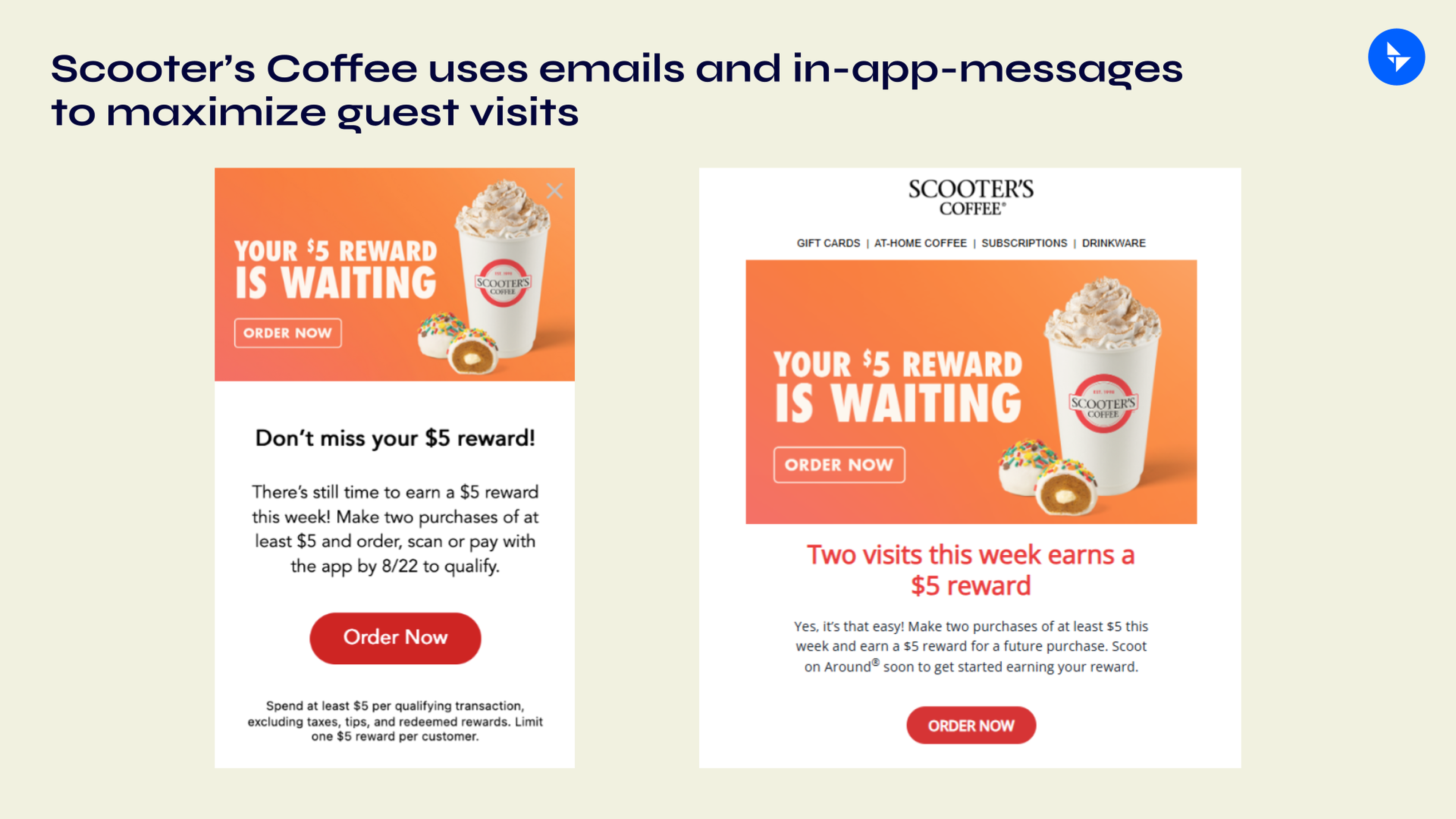
How Scooter's Coffee incentivizes customer actions
Image source
The reward still has to reflect store economics rather than subsidize visits that would have happened anyway. That is a tradeoff restaurant loyalty programs have to balance directly.
Grocery
Icelandic grocer Samkaup rotates weekly spin-to-win games in its app, with participating brands supplying the prizes. Samkaup reports that participating players spend roughly 90 percent more in stores than non-players, alongside a midweek foot-traffic increase when winners collect prizes.
The comparison reflects the retailer's own observation rather than an independently isolated cause. It does not by itself establish that the game drove the spending difference rather than simply attracting already-frequent shoppers.
Metcash, the wholesale distributor behind Australia's IGA supermarket network, has shown that gamification works just as well in the neighborhood grocery aisle as it does in a global beauty retailer's app.
In October 2025, Metcash worked with Talon.One to launch "Big Family, Big Prizes," a national gamified promotion running across more than 3,200 participating stores, making it one of the largest store collaborations Australia has ever seen. The mechanic is straightforward: spend $25 or more in a single transaction, scan a QR code, upload your receipt, and unlock a daily instant win gift card entry. Every $25 spent also earns an entry into the major prize draw, with 12 prizes worth up to $275,000 in total.
The campaign builds urgency through its high frequency of rewards, with a winner every 10 minutes and entries open daily from 7am to midnight. That constant opportunity to win creates a level of excitement that traditional points-based programs rarely match. Instead of waiting to accumulate enough points for a future reward, shoppers feel that every purchase could deliver an immediate payoff.

IGA Rewards program
Image source
Financial services
Financial services programs can turn recurring expenses into rewards categories, but the vertical carries stricter compliance requirements than retail. Regulators in the UK and US have scrutinized mechanics that exploit behavioral biases or hide earning conditions.
Transparent rules and auditable reward logic belong in the design brief from day one. Compliance should stay involved throughout development, not get brought in just before launch.
Travel and B2B
In B2B programs, non-cash incentives can sustain engagement across longer buying cycles. Visible progress keeps partners active throughout the period instead of concentrating activity around a deadline. A consumer-style daily streak rarely fits a distributor relationship.
Volume milestones or product-training achievements tend to match B2B account structures and invoice timing more naturally. That approach follows the same logic as omnichannel incentive design more broadly.
Across every vertical, the operating requirement stays the same. Progress must update accurately, and every reward must follow the rules the customer was shown.
Implementation architecture and controls
Running gamified promotions at scale usually involves several connected systems, each with a distinct role. A customer data platform such as Segment or mParticle supplies behavioral and lifecycle data. An engagement platform such as Braze can orchestrate personalized targeting, trigger journeys, and detect qualifying actions.
Segment, mParticle, and Braze are confirmed Talon.One ecosystem partners rather than competing platforms. Talon.One sits alongside them as the piece that decides eligibility, applies the reward, and enforces budget rules once a customer qualifies.
Talon.One's role in that stack covers eligibility, validation, and cost control. It handles reward delivery in real time while the commerce platform executes the result in the cart. Adobe Journey Optimizer can play a similar orchestration role. It can trigger actions such as generating a coupon code or awarding points, which a dedicated decisioning layer then evaluates.
After integration, marketers can typically configure new challenges through a rule interface without engineering support for every campaign change. The result stays out of the technical team's recurring backlog.
Controls that protect budget and integrity
Budget caps: Set redemption limits and campaign budgets before launch.
Code controls: Use unique codes where attribution matters, and prevent referral codes from spreading beyond their intended audience.
Account controls: Block duplicate accounts from farming challenges.
Stacking rules: Prevent unintended stacking across overlapping campaigns that could drain the budget.
These controls matter because hundreds of active campaigns can overlap across regions and channels, each with different eligibility rules. Teams need clear campaign priorities, exclusions, and consistent rejection reasons for customers who do not qualify. The experience stays fair even as the rule set grows complex behind the scenes.
Launch checklist
Build the checklist before production, not after launch:
Confirm event tracking, eligibility logic, progress updates, reward delivery, redemption limits, and customer messaging.
Test the normal journey and edge cases, including cancelled orders, returns, duplicate accounts, expired progress, and overlapping campaigns.
Assign an owner for live monitoring who can track participation and budget consumption after launch and has authority to pause or adjust the campaign.
Start with one behavior that has measurable commercial value. A second purchase, an off-peak store visit, a completed profile, or a lapsed customer's return all qualify. Build one simple mechanic, hold out a comparable audience where feasible, and measure incremental contribution after rewards, operations, and future loyalty liability.
If the mechanic cannot beat the control, simplify it or stop it rather than scaling it further.
Book a demo to see how Talon.One can help you configure game rules and apply budget controls in real time.
FAQs about gamified promotions


Monthly loyalty newsletter
Join thousands of marketers and developers getting the latest loyalty & promotion insights from Talon.One. Every month, you’ll receive:
Loyalty and promotion tips
Industry insights from leading brands
Case studies and best practices


Reza Javanian
Loyalty & promotion expert at Talon.One
- Company
- About us
- Press
- Jobs
- Contact us
Get the latest incentives insights, delivered straight to your inbox.

